






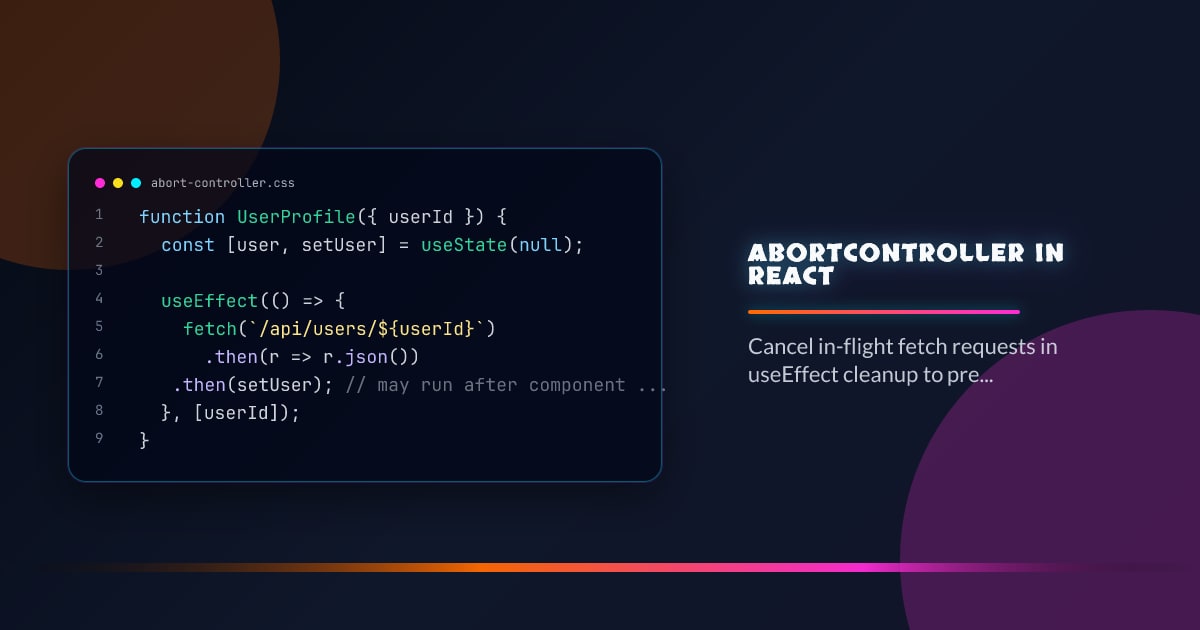
AbortController in React
AbortController lets you cancel in-flight fetch requests. In React, this is essential for cleaning up effects that start async operations.
The Problem Without Cleanup
function UserProfile({ userId }) {
  const [user, setUser] = useState(null);

  useEffect(() => {
    fetch(`/api/users/${userId}`)
      .then((r) => r.json())
      .then(setUser); // may run after component unmounts or userId changes
  }, [userId]);
}
If userId changes or the component unmounts while the fetch is in flight, setUser runs on stale or dead state.
AbortController Solution
useEffect(() => {
  const controller = new AbortController();

  fetch(`/api/users/${userId}`, { signal: controller.signal })
    .then((r) => r.json())
    .then(setUser)
    .catch((err) => {
      if (err.name === "AbortError") return; // expected — ignore
      setError(err);
    });

  return () => controller.abort(); // cancel on cleanup
}, [userId]);
When userId changes, the old effect cleans up (controller.abort()), cancelling the previous fetch before the new one starts.
Multiple Requests
One controller can abort multiple requests:
useEffect(() => {
  const controller = new AbortController();
  const { signal } = controller;

  Promise.all([
    fetch("/api/user", { signal }).then((r) => r.json()),
    fetch("/api/posts", { signal }).then((r) => r.json()),
  ])
    .then(([user, posts]) => {
      setUser(user);
      setPosts(posts);
    })
    .catch((err) => {
      if (err.name !== "AbortError") setError(err);
    });

  return () => controller.abort();
}, []);
Timeout with AbortSignal
// Manual timeout
const controller = new AbortController();
const timeoutId = setTimeout(() => controller.abort(), 5000);
fetch(url, { signal: controller.signal }).finally(() =>
  clearTimeout(timeoutId),
);

// Newer API
fetch(url, { signal: AbortSignal.timeout(5000) });
Custom Hook
function useFetch(url) {
  const [data, setData] = useState(null);
  const [error, setError] = useState(null);
  const [loading, setLoading] = useState(true);

  useEffect(() => {
    const controller = new AbortController();
    setLoading(true);

    fetch(url, { signal: controller.signal })
      .then((r) => r.json())
      .then(setData)
      .catch((err) => {
        if (err.name !== "AbortError") setError(err);
      })
      .finally(() => setLoading(false));

    return () => controller.abort();
  }, [url]);

  return { data, error, loading };
}
StrictMode and Double-Fetch
React StrictMode mounts → unmounts → remounts in dev. The abort cleanup between the two mounts cancels the first fetch. This is expected — the second mount starts a fresh request. Ensure your cleanup is correct and the AbortError is handled.
Browser support snapshot
Live support matrix for abortcontroller from
Can I Use.
Show static fallback image

Source: caniuse.com