




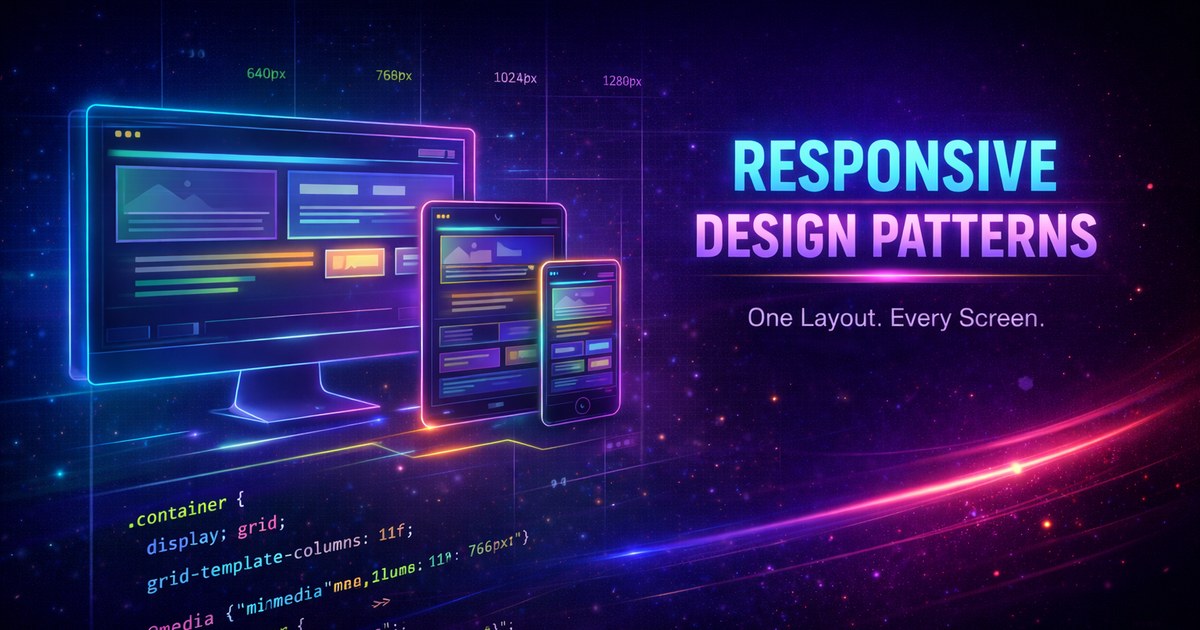
Responsive Design Patterns
Building layouts that work beautifully across all screen sizes is both an art and a science. Let’s explore modern responsive design patterns using CSS Grid, Flexbox, and container queries.
Container Queries
The game-changer for component-based responsive design:
.card-container {
  container-type: inline-size;
  container-name: card;
}

@container card (min-width: 400px) {
  .card {
    grid-template-columns: 200px 1fr;
  }
}
Fluid Typography
Scale text smoothly with clamp():
h1 {
  font-size: clamp(2rem, 5vw + 1rem, 4rem);
}
Grid Layouts
Auto-responsive grids without media queries:
.grid {
  display: grid;
  grid-template-columns: repeat(auto-fit, minmax(min(250px, 100%), 1fr));
  gap: 1rem;
}
Flexbox Patterns
Flexible layouts that adapt naturally:
.flex-wrap {
  display: flex;
  flex-wrap: wrap;
  gap: 1rem;
}

.flex-item {
  flex: 1 1 300px;
}
Modern Stack Layout
Use logical properties for better internationalization:
.stack {
  display: flex;
  flex-direction: column;
  gap: var(--space-md);
}
Aspect Ratio Boxes
Maintain aspect ratios with aspect-ratio:
.video-container {
  aspect-ratio: 16 / 9;
}
Conclusion
Modern CSS gives us powerful tools for responsive design. Container queries, in particular, enable truly modular components that adapt to their context, not just the viewport.
Browser support snapshot
Live support matrix for css-mediaqueries from
Can I Use.
Show static fallback image

Source: caniuse.com