





Stale Closures in React
A stale closure is a function that captured a value from a previous render and still references that old value. It’s one of the most common sources of subtle bugs in React hooks.
The Basic Problem
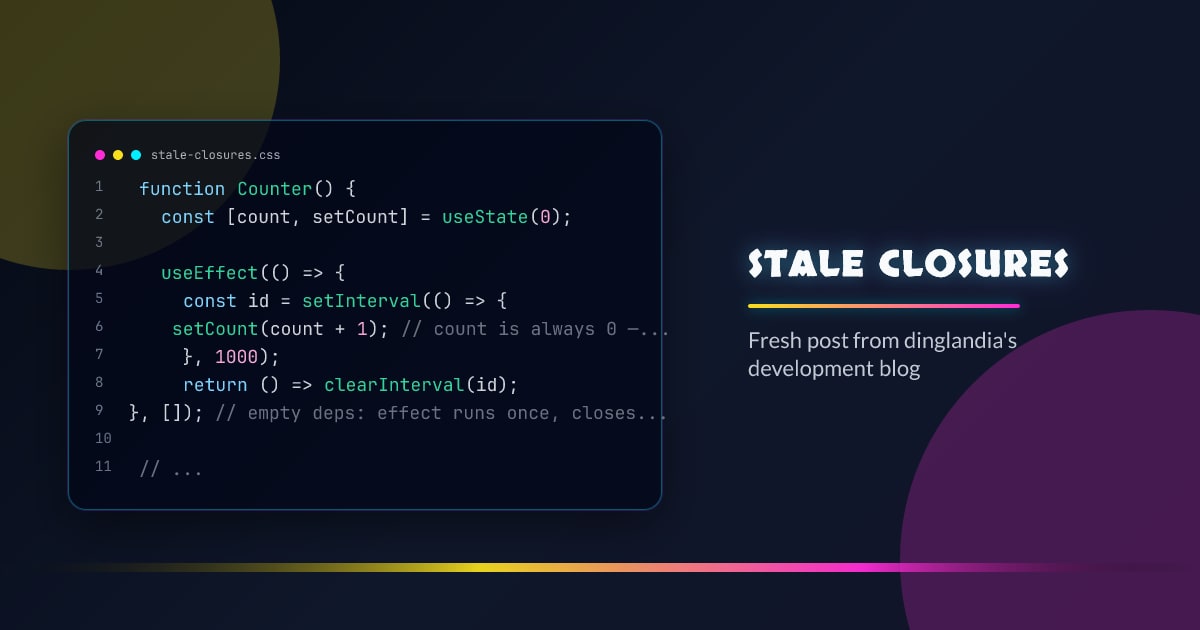
function Counter() {
  const [count, setCount] = useState(0);

  useEffect(() => {
    const id = setInterval(() => {
      setCount(count + 1); // count is always 0 — captured on mount
    }, 1000);
    return () => clearInterval(id);
  }, []); // empty deps: effect runs once, closes over count=0

  return <div>{count}</div>;
}
The count never gets past 1. The interval callback captured count = 0 on mount and never gets a fresh copy.
Fix 1: Functional Update
Use the updater function form to avoid reading stale state:
useEffect(() => {
  const id = setInterval(() => {
    setCount((c) => c + 1); // receives current value at dispatch time
  }, 1000);
  return () => clearInterval(id);
}, []);
The updater c => c + 1 receives the current state at the moment it’s dispatched, not at capture time. No stale closure.
Fix 2: Correct Dependencies
Add the captured value to the dependency array:
useEffect(() => {
  const id = setInterval(() => {
    setCount(count + 1);
  }, 1000);
  return () => clearInterval(id);
}, [count]); // effect re-runs when count changes
This creates a new interval on every count change — correct, but potentially not the intended behavior.
Fix 3: useRef for Mutable Values
For callbacks that need the latest value without re-running the effect:
function useLatest(value) {
  const ref = useRef(value);
  useEffect(() => {
    ref.current = value;
  });
  return ref;
}

function Counter() {
  const [count, setCount] = useState(0);
  const latestCount = useLatest(count);

  useEffect(() => {
    const id = setInterval(() => {
      setCount(latestCount.current + 1); // always current
    }, 1000);
    return () => clearInterval(id);
  }, []);
}
Stale Closures in Event Handlers
function App() {
  const [message, setMessage] = useState("hello");

  const handleClick = useCallback(() => {
    console.log(message); // stale if message is missing from deps
  }, []); // forgot to add message
}
Adding message to useCallback deps fixes it but regenerates the callback on every change — trade-off between freshness and stability.
useReducer Avoids the Problem
useReducer dispatch is always stable and the reducer always receives current state:
const [state, dispatch] = useReducer(reducer, initialState);

useEffect(() => {
  const id = setInterval(() => {
    dispatch({ type: "INCREMENT" }); // no stale closure — no state read
  }, 1000);
  return () => clearInterval(id);
}, []);