





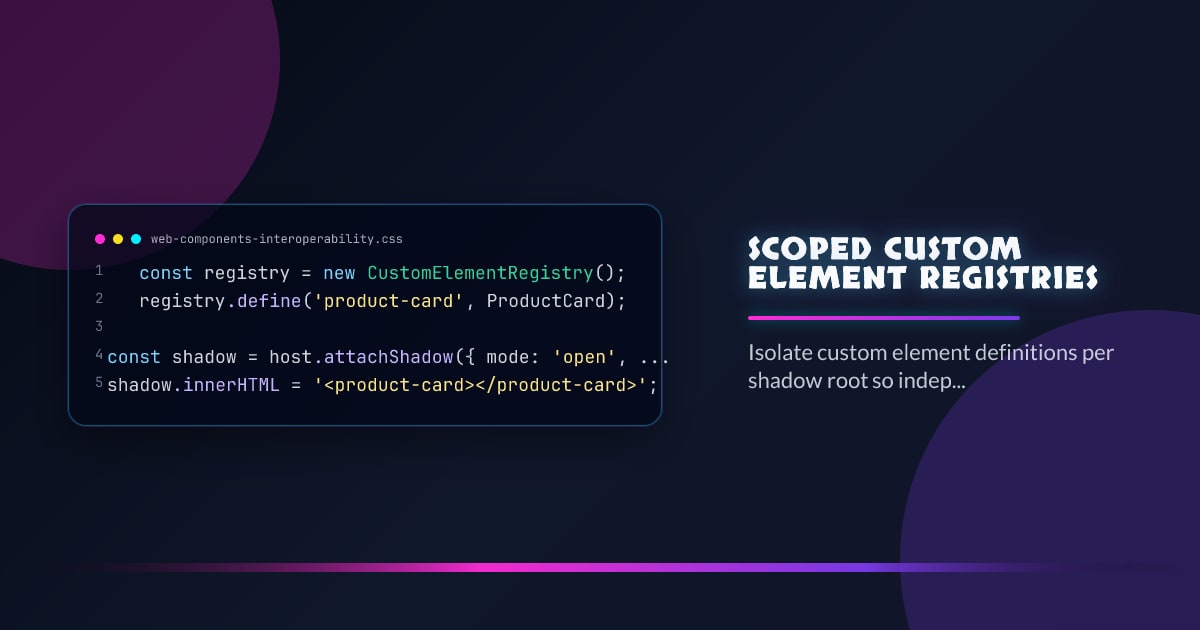
Scoped Custom Element Registries
Web components become much easier to compose across teams when element definitions stop fighting over the single global registry. Scoped custom element registries are the interop piece that makes independently versioned component islands far more realistic.
const registry = new CustomElementRegistry();
registry.define("product-card", ProductCard);

const shadow = host.attachShadow({ mode: "open", registry });
shadow.innerHTML = "<product-card></product-card>";
The Problem It Solves
Today, custom element names are global per document. That means micro-frontends, embedded widgets, or design-system migrations can collide even when they live in otherwise isolated parts of the page. Scoped registries move the definition boundary closer to the component tree that owns it.
Where It Helps Most
This matters for host applications embedding third-party widgets, gradual design-system rewrites, and web-component libraries that need to support multiple versions side by side. It is an interoperability feature in the literal sense: separate things can finally coexist cleanly.
Keep the Scope Intentional
Do not create a fresh registry for every tiny leaf component. Scope at meaningful boundaries such as an app shell, feature island, or embedded widget so the dependency graph stays understandable.
Shipping Strategy
Feature-detect support and keep a global-registry fallback for older browsers. Even before the fallback goes away, designing your components around explicit ownership of definitions will make later adoption smoother.
Browser support snapshot
Live support matrix for wf-scoped-custom-element-registries from
Can I Use.
Show static fallback image

Source: caniuse.com