






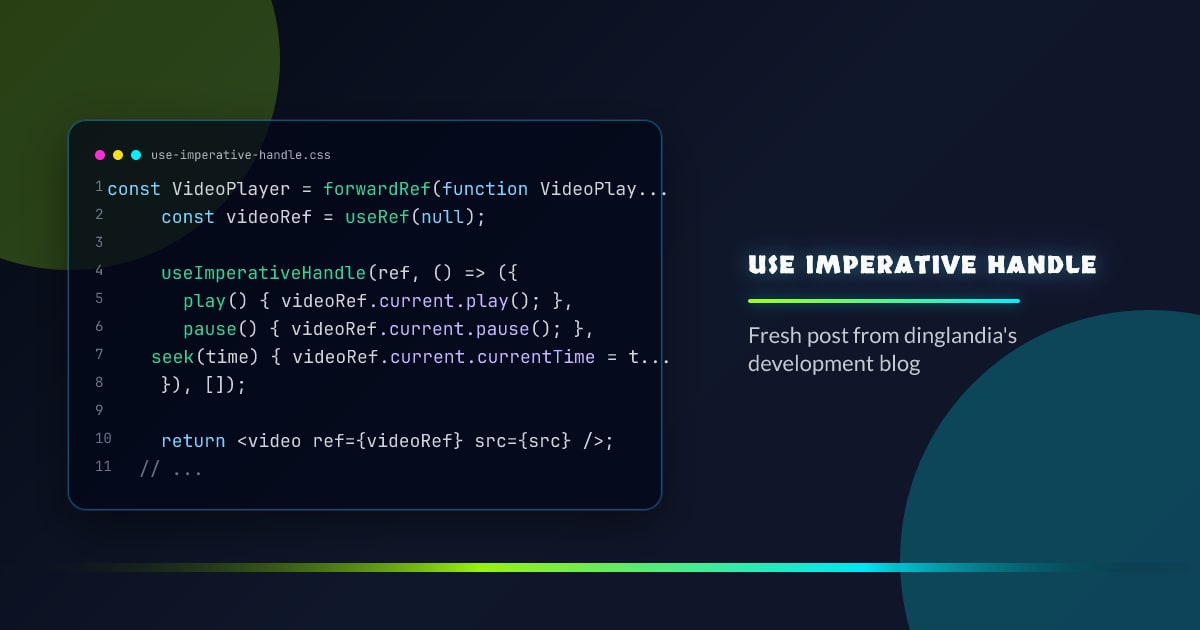
useImperativeHandle
useImperativeHandle lets a component expose a custom imperative API to its parent via a ref, instead of exposing the raw DOM node.
Basic Usage
const VideoPlayer = forwardRef(function VideoPlayer({ src }, ref) {
  const videoRef = useRef(null);

  useImperativeHandle(
    ref,
    () => ({
      play() {
        videoRef.current.play();
      },
      pause() {
        videoRef.current.pause();
      },
      seek(time) {
        videoRef.current.currentTime = time;
      },
    }),
    [],
  );

  return <video ref={videoRef} src={src} />;
});

// Parent
function App() {
  const playerRef = useRef(null);
  return (
    <>
      <VideoPlayer ref={playerRef} src="/video.mp4" />
      <button onClick={() => playerRef.current.play()}>Play</button>
      <button onClick={() => playerRef.current.pause()}>Pause</button>
    </>
  );
}
The parent gets a controlled API with only play, pause, and seek — not the raw <video> element and all its properties.
Signature
useImperativeHandle(ref, createHandle, deps?)ref— the forwarded ref fromforwardRefcreateHandle— factory returning the object to exposedeps— recomputes the handle when deps change (likeuseMemo)
Why Not Just Expose the DOM Node
Exposing the raw node gives parents unrestricted access. useImperativeHandle lets you:
- Expose only a stable, intentional API
- Validate or wrap calls (e.g., add logging or guards)
- Change the underlying implementation without breaking the parent’s API
Common Use Cases
- Focus management:
modal.focus(),input.focus() - Media control:
player.play(),player.pause() - Scroll:
list.scrollToIndex(n) - Animation triggers:
dialog.open(),dialog.close()
React 19
In React 19, skip forwardRef:
function VideoPlayer({ src, ref }) {
  const videoRef = useRef(null);

  useImperativeHandle(
    ref,
    () => ({
      play: () => videoRef.current.play(),
      pause: () => videoRef.current.pause(),
    }),
    [],
  );

  return <video ref={videoRef} src={src} />;
}
Don’t Overuse
Imperative handles break the declarative React model. Prefer props and state for most interactions. Reach for useImperativeHandle only when a ref is genuinely the right pattern — focus management and media control are the clearest cases.